traditional graphics pipeline
COS 350 - Computer Graphics
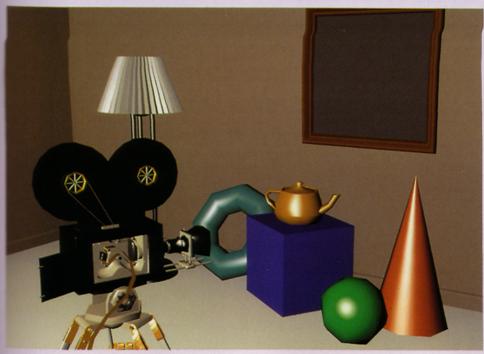
graphics pipeline
- sequence of operations to generate an image using object-order processing
- primitives processed one-at-a-time
- software pipeline: e.g. Renderman (old)
- high-quality and efficiency for large scenes
- hardware pipeline: e.g. graphics accelerators
- lower-quality solution for interactive applications
- will cover algorithms of modern hardware pipeline (pre RTX)
- but evolve drastically every few years
- we will only look at triangles
graphics pipeline
- handles only simple primitives by design
- point, lines, triangles, quads (as two triangles)
- efficient algorithm
- complex primitives by tessellation
- complex curves: tessellate into line strips
- complex surfaces: tessellate into triangle meshes
- "pipeline" name derives from architecture design
- sequences of stages with defined input/output
- easy-to-optimize, modular design
graphics pipeline
- object-local algorithm
- processes only one-surface-at-a-time
- various effects have to be approximated
- shadows: shadow volume and shadow maps
- reflections: environment mapping or screen-space
- hard to implement
- advanced effects cannot be implemented without hacks
- soft shadows
- blurry reflections and diffuse-indirect illumination
graphics pipeline stages
|
|
vertex data |
| transformations |
\(\,\rightarrow\,\) |
[ vertex processing ] |
|
|
transformed vertex data |
| convert to pixels |
\(\,\rightarrow\,\) |
[ clipping and rasterization ] |
|
|
fragments w/ interpolated data |
| compute final colors |
\(\,\rightarrow\,\) |
[ fragment processing ] |
|
|
fragments color and depth |
| blending hidden-surface |
\(\,\rightarrow\,\) |
[ framebuffer processing ] |
|
|
framebuffer |
only a subset of modern pipeline stages (tessellation, geometry, vertex post-process, primitive assemly)
graphics pipeline stages
- vertex processing
- input: vertex data (position, normal, color, etc.)
- output: transformed vertices in homogeneous canonical view-volume, colors, etc.
- applies transformation from object-space to clip-space
- passes along material and shading data
- clipping and rasterization
- turns sets of vertices into primitives and fills them in
- output: set of fragments with interpolated data
graphics pipeline stages
- fragment processing
- output: final color and depth
- traditionally mostly for texture lookups
- lighting was computed for each vertex
- today, computes lighting per-pixel
- framebuffer processing
- output: final picture
- hidden surface elimination
- compositing via alpha-blending
vertex processing
| vertex data |
| [ vertex processing ] |
| transformed vertex data |
| [ clipping and rasterization ] |
| fragments w/ interpolated data |
| [ fragment processing ] |
| fragments color and depth |
| [ framebuffer processing ] |
| framebuffer |
vertex processing
- transform vertices from model to clip space
![[Marschner 2004]](33_ImageFormation_Pipeline/images/transform_obj2clip.jpg?A9MD) [Marschner 2004]
[Marschner 2004]
vertex processing
- other geometry tasks
- deformation: skinning, mesh blending
- low-quality lighting
- pass other properties to next stages of pipeline
- the only place to algorithmically alter shape
- programmable hardware unit
- algorithm can be changed at run-time by application
clipping and rasterization
| vertex data |
| [ vertex processing ] |
| transformed vertex data |
| [ clipping and rasterization ] |
| fragments w/ interpolated data |
| [ fragment processing ] |
| fragments color and depth |
| [ framebuffer processing ] |
| framebuffer |
clipping and rasterization
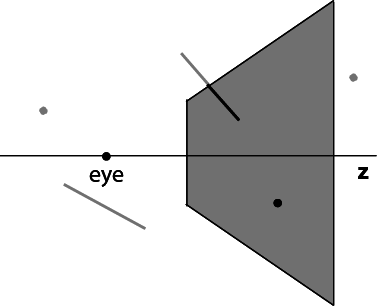
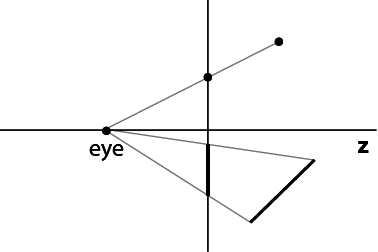
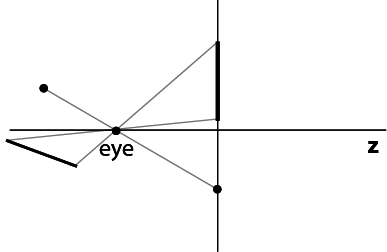
- remove (partial) objects not in the view frustum
- efficiency: cull later stages of the pipeline
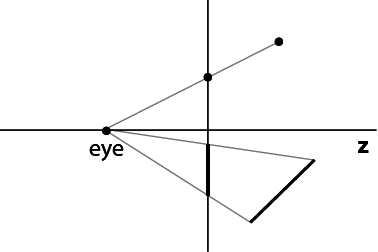
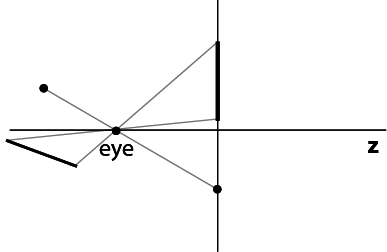
- correctness: perspective transform can cause trouble
- often referred as culling when full objects removed
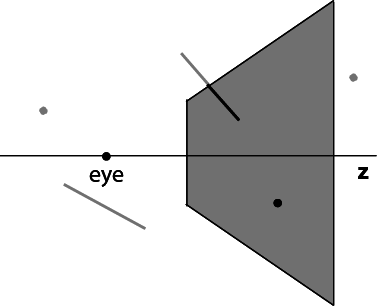
clipping to ensure correctness
| in front of eye |
behind eye |
 |
 |
point clipping
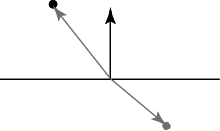
- point-plane clipping
- test if the point is on the right side of the plane
- by taking dot-product with the plane normal
- can be performed in homogeneous coordinates
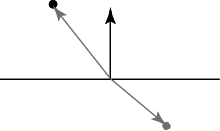
- point-frustum clipping
- point-plane clipping for each frustum plane
line clipping
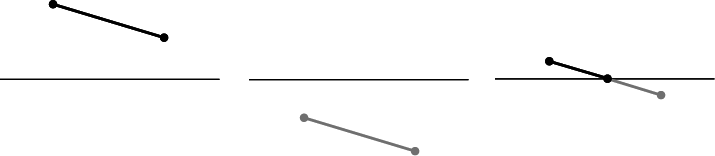
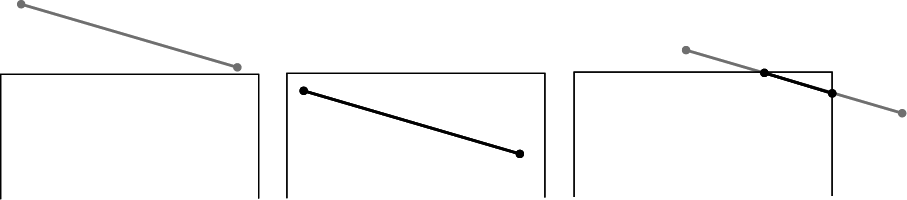
- segment-plane clipping
- test point-plane clipping for endpoints
- if endpoints are clipped, clip whole segment
- if endpoints are not clipped, accept whole segment
- if one endpoint is clipped, clip segment
- compute segment-plane intersection
- create shorter segment
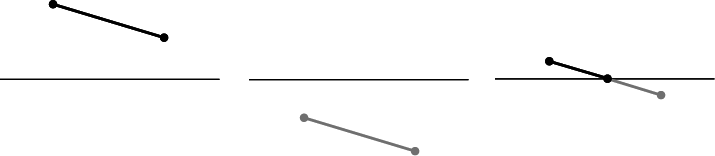
line clipping
- segment-frustum clipping
- clip against each plane incrementally
- guarantee to create the correct segment
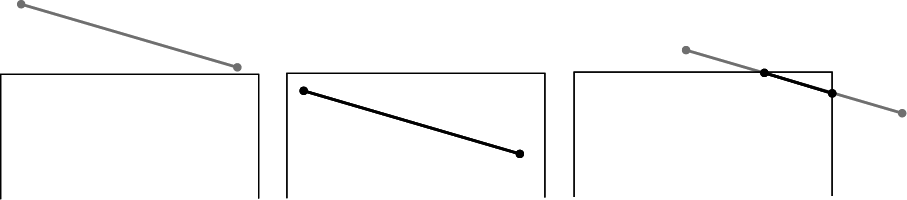
- more efficient algorithms available
- previous incremental approach might try too hard
- provide early rejection for common cases
- so, only clip when necessary
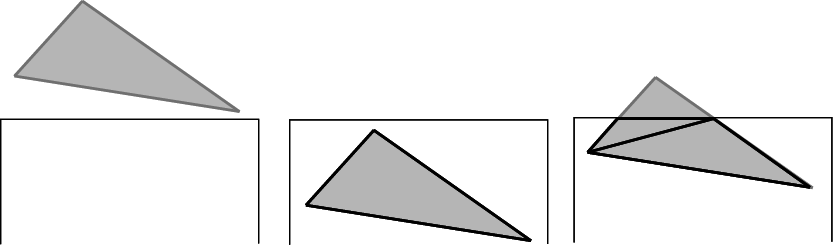
polygon clipping
- convex polygons similar to line clipping
- clip each point in sequence
- remove outside points
- create new points on boundary
- clipped triangles are not necessarily triangles
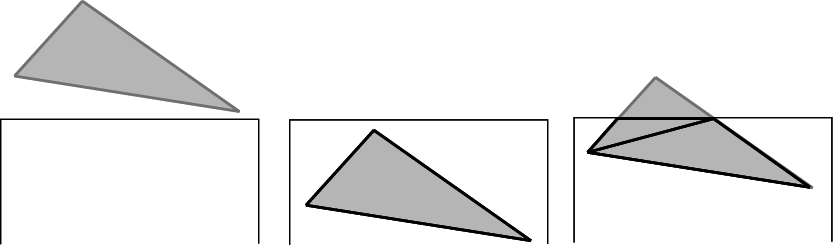
culling
- further optimize by rejecting "useless" triangles
- backface culling
- if triangle face is oriented away from camera, cull it
- only ok for closed surfaces
- early z-culling
- if triangle is behind existing scene, cull it
- uses z-buffer introduced later on
viewport transformation
- transform the canonical view volume to the pixel coordinates of the screen
- also rescale \(z\) in the \([0...1]\) range
- perspective divide is often performed here
![[Marschner 2004]](33_ImageFormation_Pipeline/images/transform_viewport.jpg?MYWK) [Marschner 2004]
[Marschner 2004]
rasterization
- approximate primitives into pixels
- pixel centered at integer coordinates
- determine which pixels to turn on
- no anti-aliasing (jaggies): pixel in the primitive
- consider anti-aliasing for some primitives
- input: vertex position in homogeneous coordinates
- interpolate values across primitive
- color, normals, position at vertices
- input: any vertex property
See S10_Algorithms for more details on rasterization
fragment processing
| vertex data |
| [ vertex processing ] |
| transformed vertex data |
| [ clipping and rasterization ] |
| fragments w/ interpolated data |
| [ fragment processing ] |
| fragments color and depth |
| [ framebuffer processing ] |
| framebuffer |
fragment processing
- compute final fragment colors, alphas, and depth
- depth is often untouched if no special effects
- final lighting computations
- lots of texture mapping: see later
- programmable hardware unit
- algorithm can be changed at run-time by application
lighting computation
- where to evaluate lighting?
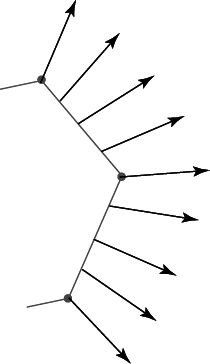
- flat: at vertices but do not interpolate colors
- Gouraud: at vertices, with interpolated color
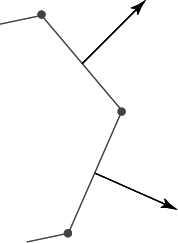
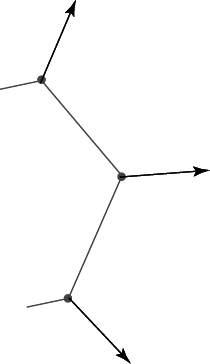
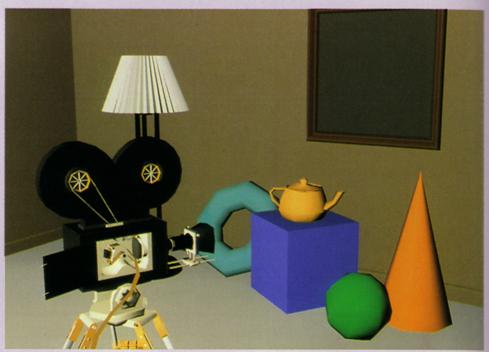
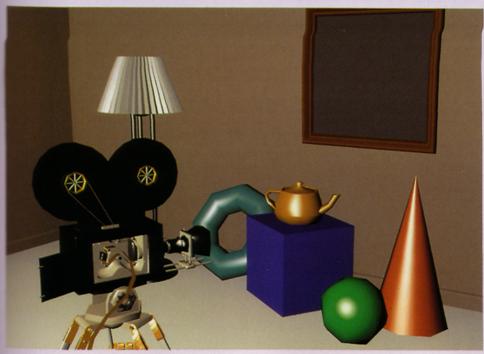
- Phong: at fragments, with interpolated normals
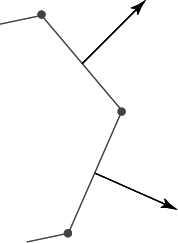
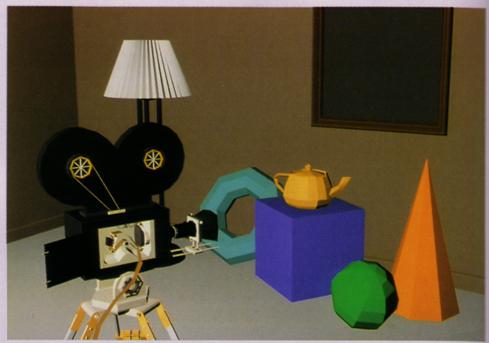
lighting computation - flat shading
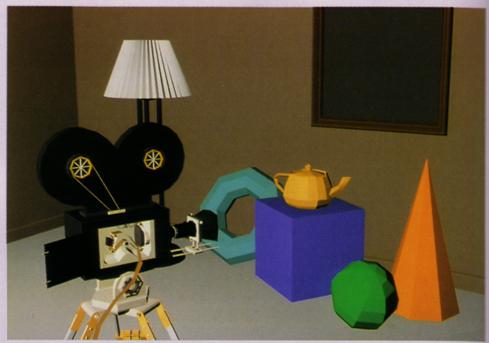
- compute using normals of the triangle
- flat and faceted look
- correct: no geometrical inconsistency
lighting computation - Gouraud shading
- compute light at vertex position
- interpolate colors linearly over the triangle
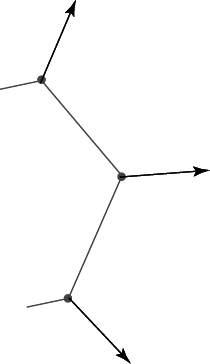
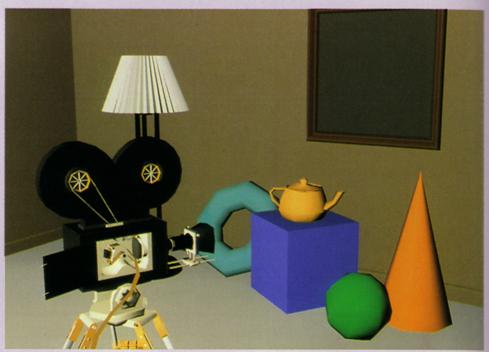
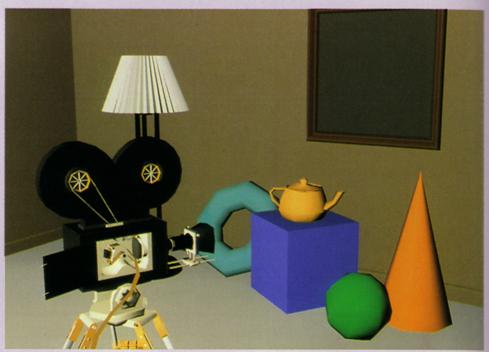
lighting computation - Phong shading
- interpolate normals per-pixels: shading normals
- compute lighting for each pixel
- lighting depends less on tessellation
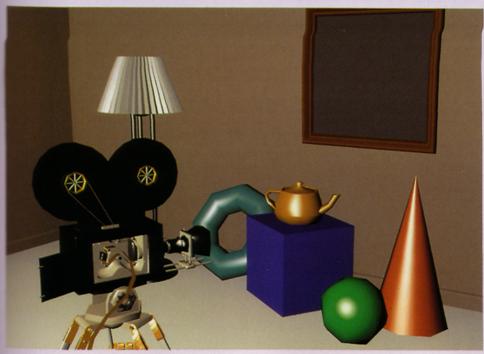
lighting computation comparison
| Gouraud |
Phong |
 |
 |
| artifacts in highlights |
good highlights |
lighting computation
- per-pixel lighting is becoming ubiquitous
- much more robust
- move lighting from vertex to fragment processing
- new hardware architectures allow for this
- we introduce Gouraud for historical reasons
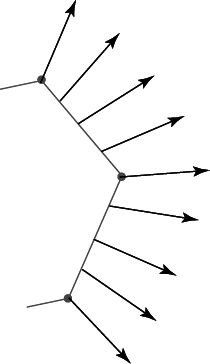
- raytracing can have this by using shading normals
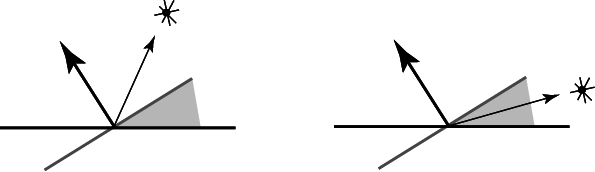
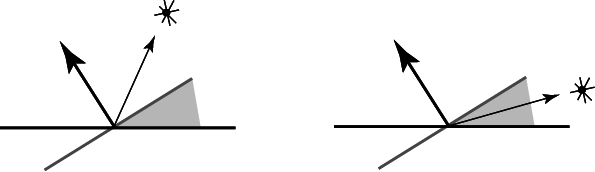
lighting computation
- shading normals introduce inconsistencies
- lights can come from "below" the surface
framebuffer processing
| vertex data |
| [ vertex processing ] |
| transformed vertex data |
| [ clipping and rasterization ] |
| fragments w/ interpolated data |
| [ fragment processing ] |
| fragments color and depth |
| [ framebuffer processing ] |
| framebuffer |
framebuffer processing
- hidden surface elimination
- decides which surfaces are visible
- framebuffer blending
- composite transparent surfaces if necessary
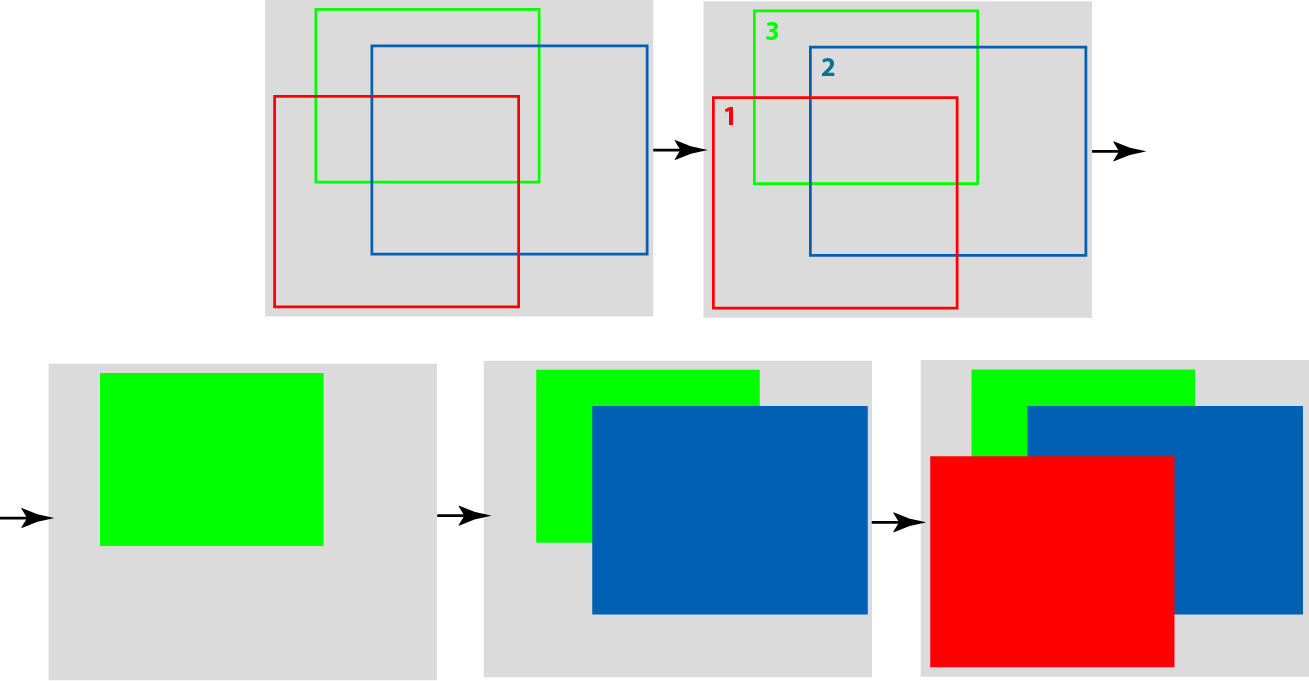
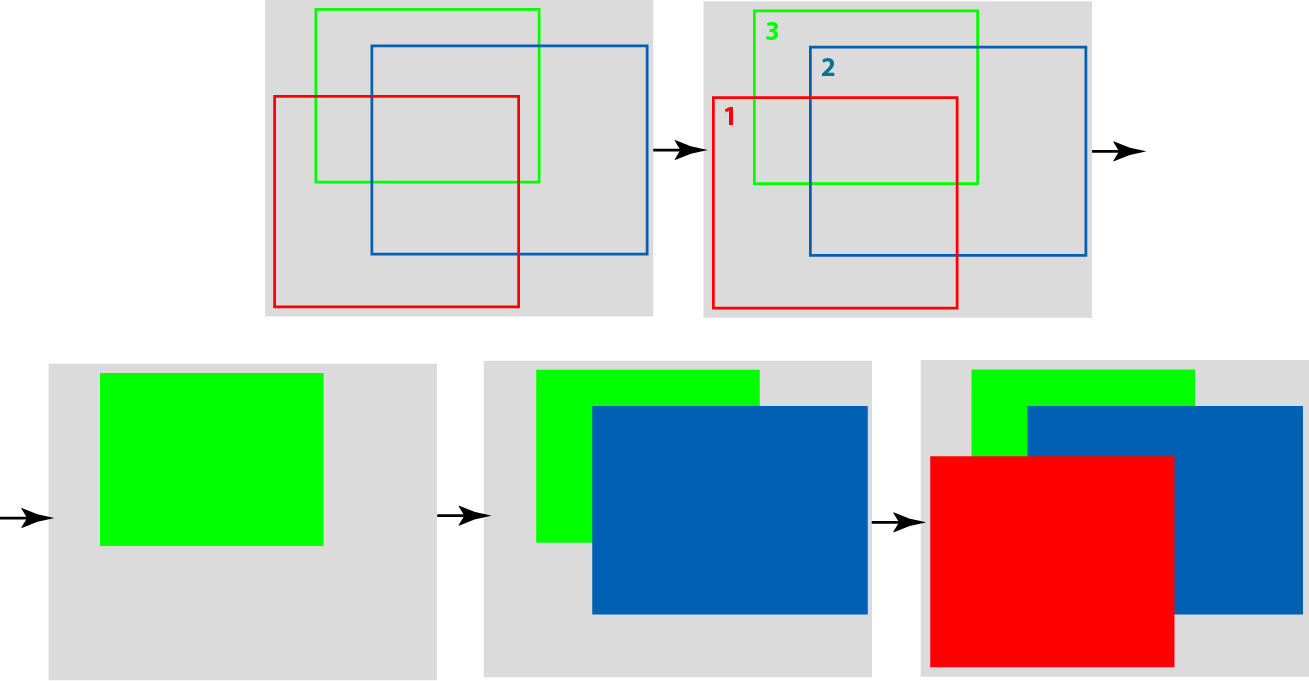
hidden surface removal - painter alg.
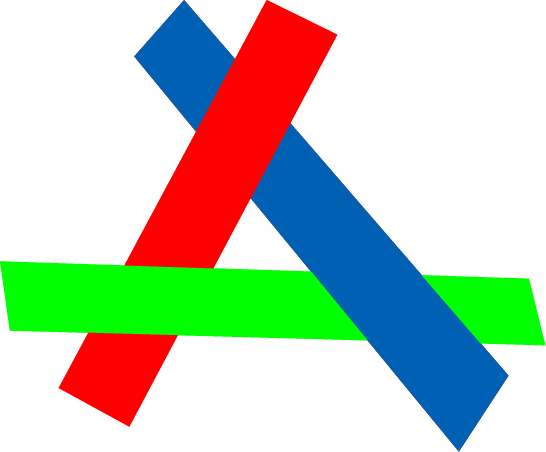
- sort objects back to front
- draw in sorted order
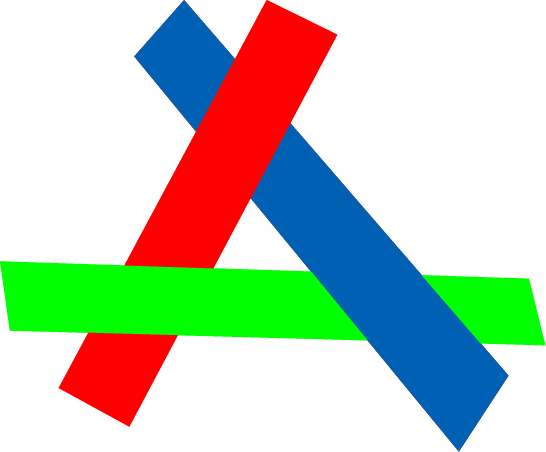
- does not work in many cases
hidden surface removal - painter alg.
- sort objects back to front
- draw in sorted order
- does not work in many cases
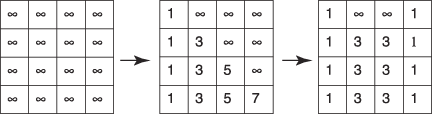
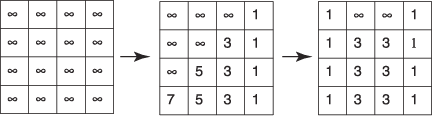
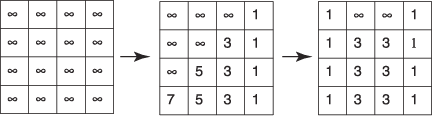
hidden surface removal - z buffer
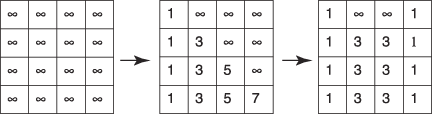
- brute force algorithm
- for each pixel, keep distance to closest object
- for each object, rasterize updating pixels if distance is closer
- opaque objects: works in every case
- transparent objects: cannot properly composite
hidden surface removal - z buffer
| z-buffer |
 |
| color buffer |
 |
[ adapted from Shirley ]
hidden surface removal - z buffer
| z-buffer |
 |
| color buffer |
 |
[ adapted from Shirley ]
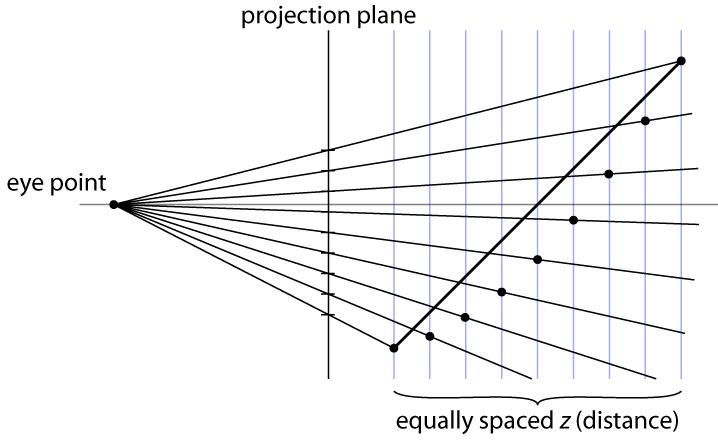
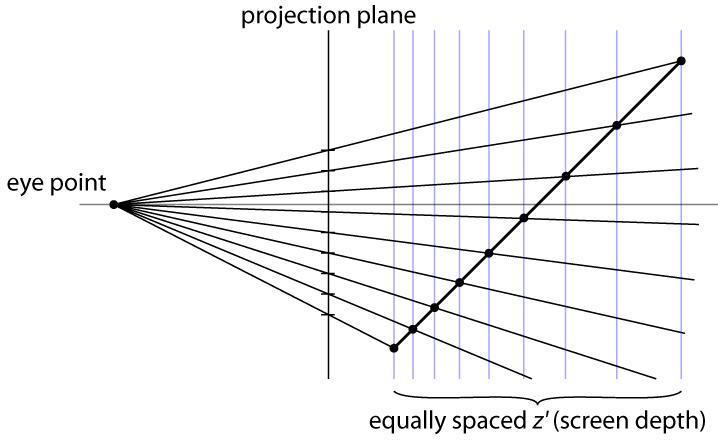
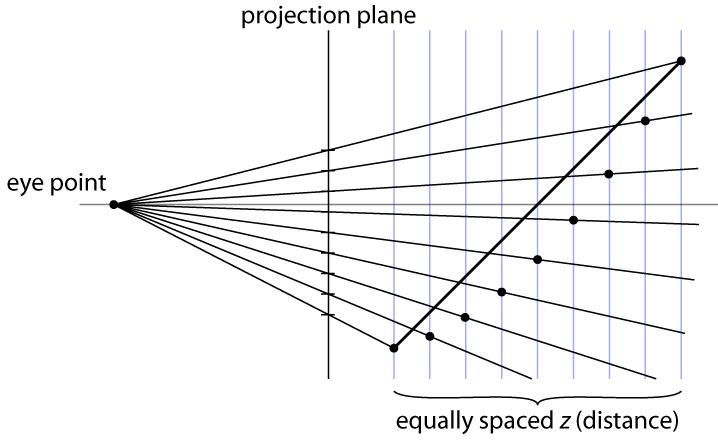
which z distance
- use z value after homogeneous xform
- linear interpolation works
- storage non-linear: more precision around near frame
[ Marschner 2004 ]
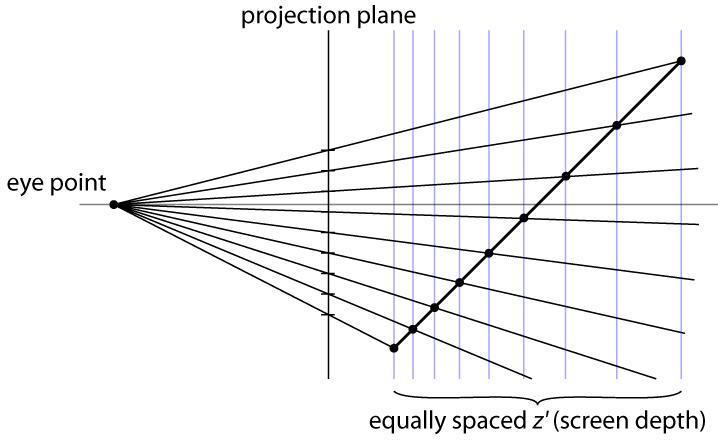
which z distance
- use z value after homogeneous xform
- linear interpolation works
- storage non-linear: more precision around near frame
[ Marschner 2004 ]
hidden surface removal - raycasting
- for each ray, find intersection to closest surface
- works for opaque and transparent objects
- loops over pixels and then over surfaces
- inefficient
- would like to loop over surfaces only once
hidden surface removal - scanline
- for each scanline, sort primitives
- incremental rasterization
- sorting can be done in many ways
- needs complex data structures
- works for opaque and transparent objects
hidden surface removal - REYES
- for each primitives, turn into small grids of quads
- hit-test quads by ray-casting
- keep list of sorted hit-points per pixel
- like z-buffer but uses a list
- works for opaque and transparent objects
- hybrid between raycast and z-buffer
- very efficient for high complexity
- when using appropriate data-structures
- solves many other problems we will encounter later
framebuffer processing
- hidden surface elimination using Z-buffer
- framebuffer blending using \(\alpha\)-compositing
- but cannot sort fragments properly
- incorrect transparency blending
- need to presort transparent surfaces only
- like painter's algorithm, so not correct in many cases
traditional graphics pipeline
why?
why graphics pipelines?
- simple algorithms can be mapped to hardware
- high performance using on-chip parallel execution
- highly parallel algorithms
- memory access tends to be coherent
- one object at a time
traditional graphics pipeline architecture
- multiple arithmetic units
- NVidia Geforce GTX Titan: 2688 stream processors
- very small caches
- not needed since memory accesses are very coherent
- fast memory architecture
- needed for color/z-buffer traffic
- restricted memory access patterns
- no read-modify-write
- bound to change hopefully
- easy to make fast: this is what Intel would love!
- research into using for scientific computing
graphics pipelines vs. raytracing
|
raycasting
- foreach pixel, foreach obj
- project pixels onto objects
- discretize first
- access objects many times
- very general solution
- \(O(\log(n))\) w/ accel. struct.
|
graphics pipeline
- foreach obj, foreach pixel
- project objects onto pixels
- discretize last
- access objs once
- hard for complex effects
- \(O(n)\) or lower sometimes
|
what about RTX?
- the relatively new RTX architecture changes Everything!†
- adds raytrace abilities into graphics pipeline
- true reflections, refractions, shadows
- indirect lighting and ambient occlusion
- lens and motion blur
- considered a hybrid image render approach
- still very limited and requires some "black magic"
- raytraced image contains very low samples and requires denoising filters
- requires acceleration structures
† kind of
![[Marschner 2004]](33_ImageFormation_Pipeline/images/transform_obj2clip.jpg)
![[Marschner 2004]](33_ImageFormation_Pipeline/images/transform_viewport.jpg)