Projection
COS 350 - Computer Graphics
perspective projection in drawing
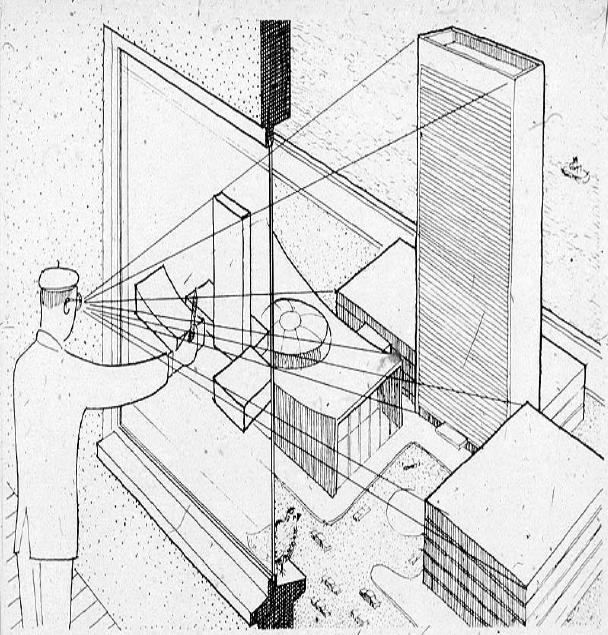
perspective projection in drawing
perspective was not used until circa 15th century
technical explanation by Leon Battista Alberti
1436, De Pictura – Della Pittura
“Trovai adunque io questo modo ottimo cosi in tutte le cose seguendo quanto dissi, ponendo il punto centrico, traendo indi linee alle divisioni della giacente linea del quadrangolo. (tts)
”
perspective projection in drawing
perspective was not used until circa 15th century
technical explanation by Leon Battista Alberti
1436, De Pictura – Della Pittura
“Trovai adunque io questo modo ottimo cosi in tutte le cose seguendo quanto dissi, ponendo il punto centrico, traendo indi linee alle divisioni della giacente linea del quadrangolo. (tts)
”
“Therefore, I found this so great as in all things according to what I said , putting the centric point , then drawing lines to the divisions of the line lying quadrangle.
”
perspective projection in drawing
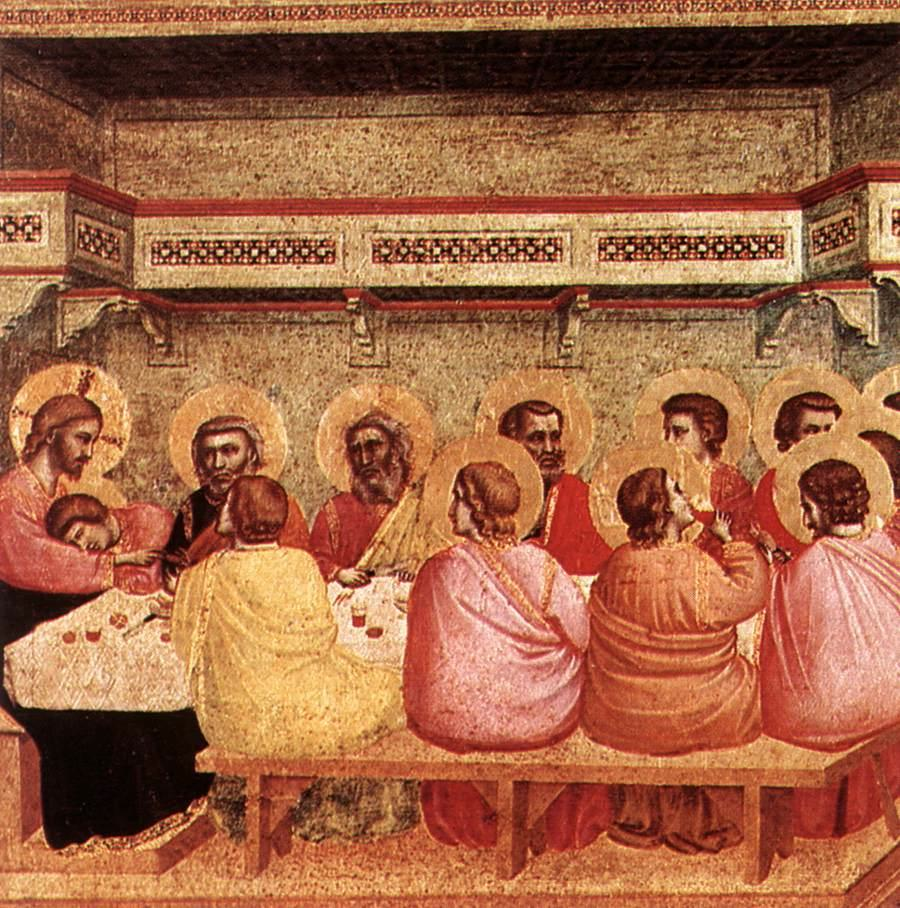
perspective projection in drawing
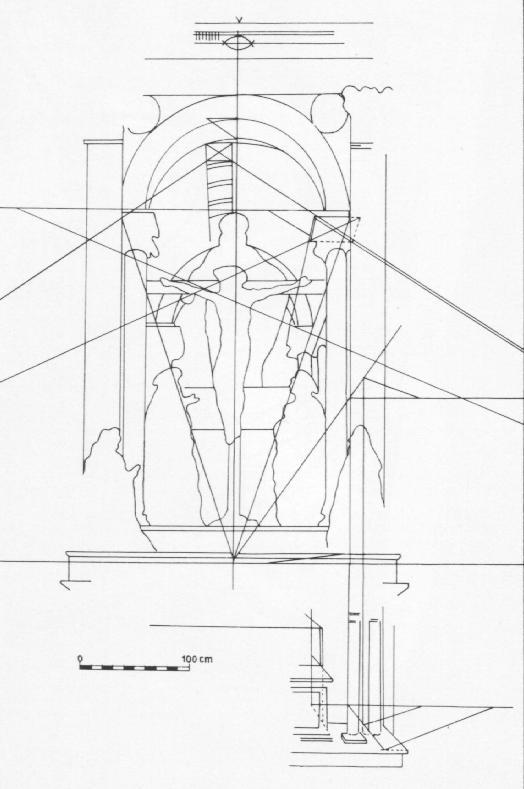
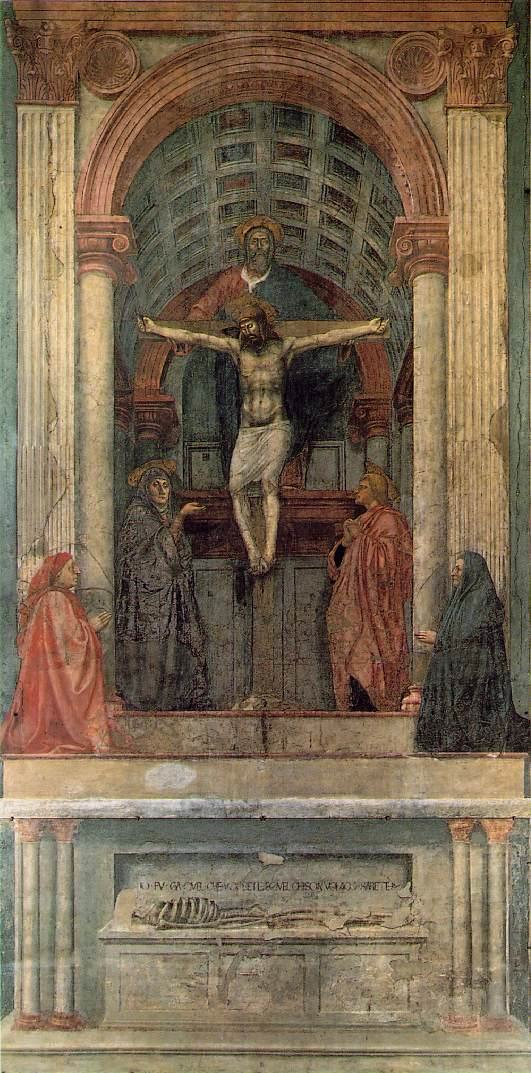
perspective projection in photography
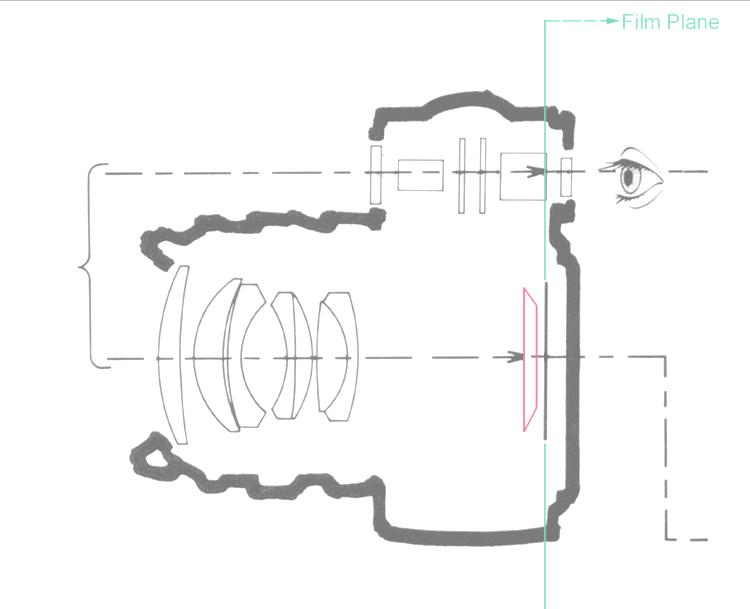
perspective projection in photography
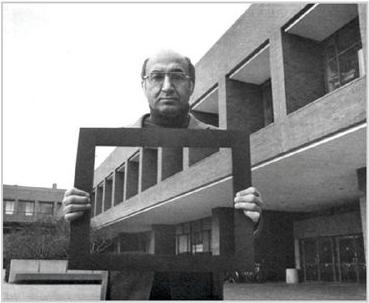
perspective projection in photography
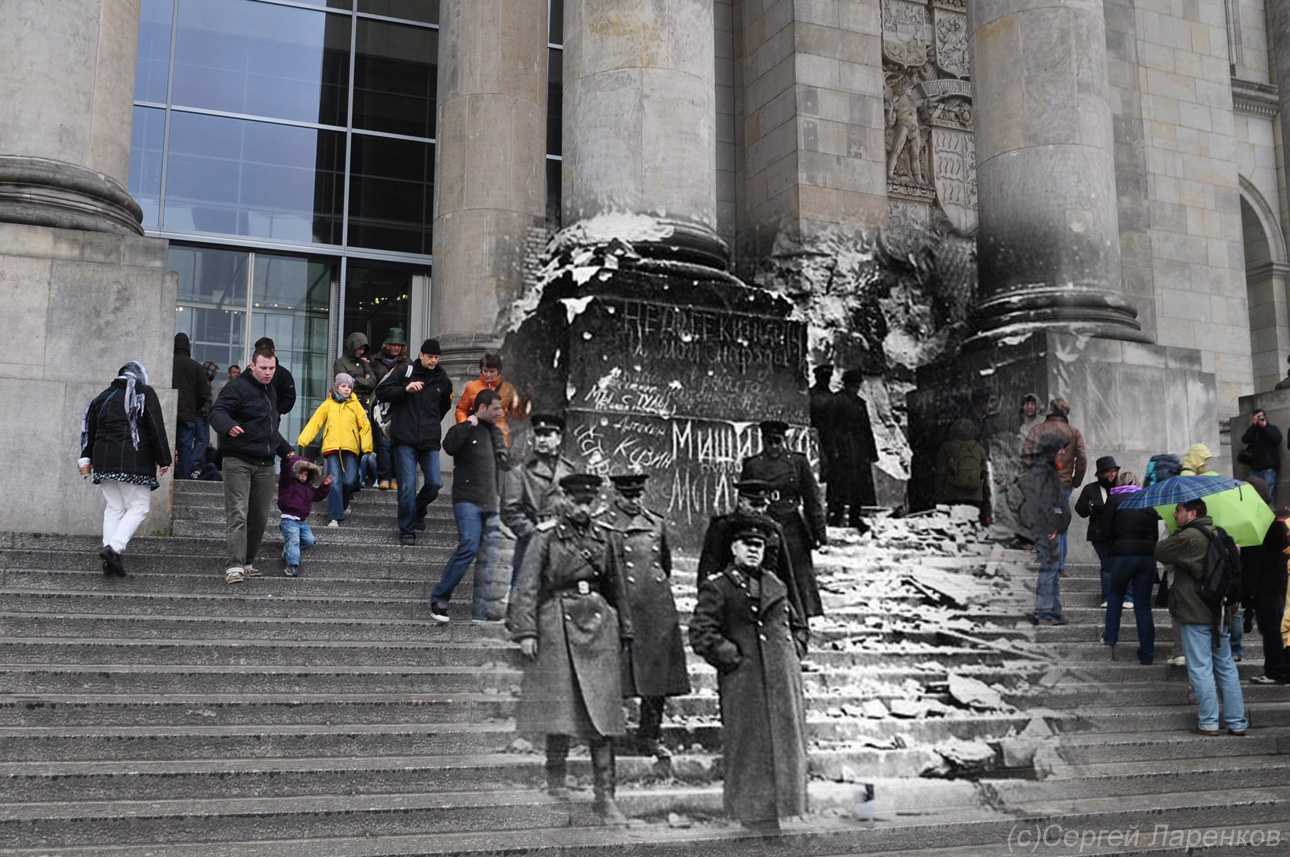
raytracing vs. projection
ray tracing: image plane to object point
- start with image point
- generate a ray
- determine the visible object point
projection: object point to image plane
- start with an object point
- apply transforms
- determine the image plane point it projects to
inverse process
projection
maps 3D world points to 2D image plane positions
two stages:
- viewing transform
- map world coordinates to camera coordinates
- change of coordinate system
- projection transform
- map camera coordinates to image plane coordinates
- typically orthographic or perspective
viewing transform
viewing transform changes coord system of points from world to view / camera space
can be any affine transform
- useful to define one for our viewer model
- defined by origin, forward (or target), up
- computed by
- orthonormalized frame from the vectors
- construct a matrix for a change of coord. system
- seen in previous lecture
projection transform
in general, function that transforms points from \(m\)-space to \(n\)-space, where \(m > n\)
in graphics, maps 3D points in view space to projection space
- NOTE: we will keep around the third coordinate!
- we map points to locations in image by bounding the projection space and mapping
- typically box: left, right, top, bottom, front/near, back/far
- each defined as clipping planes
- called a view volume; everything outside is not rendered
- typically box: left, right, top, bottom, front/near, back/far
why introduce near/far clipping planes?
- mostly to reduce \(z\) range, motivated later
canonical view volume
- the black points are inside the view volume, so they will be rendered
- the gray points are outside the view volume, so they will NOT be rendered
canonical view volume
\((x,y)\) are image plane coordinates in \([-1,1] \times [-1,1]\)
keep around the \(z\) normalized in \([-1,1]\)
- define a near and far distance
- everything on the near plane has \(z=1\)
- everything on the far plane has \(z=-1\)
- inverted \(z\)!
- will become useful later on
taxonomy of projections
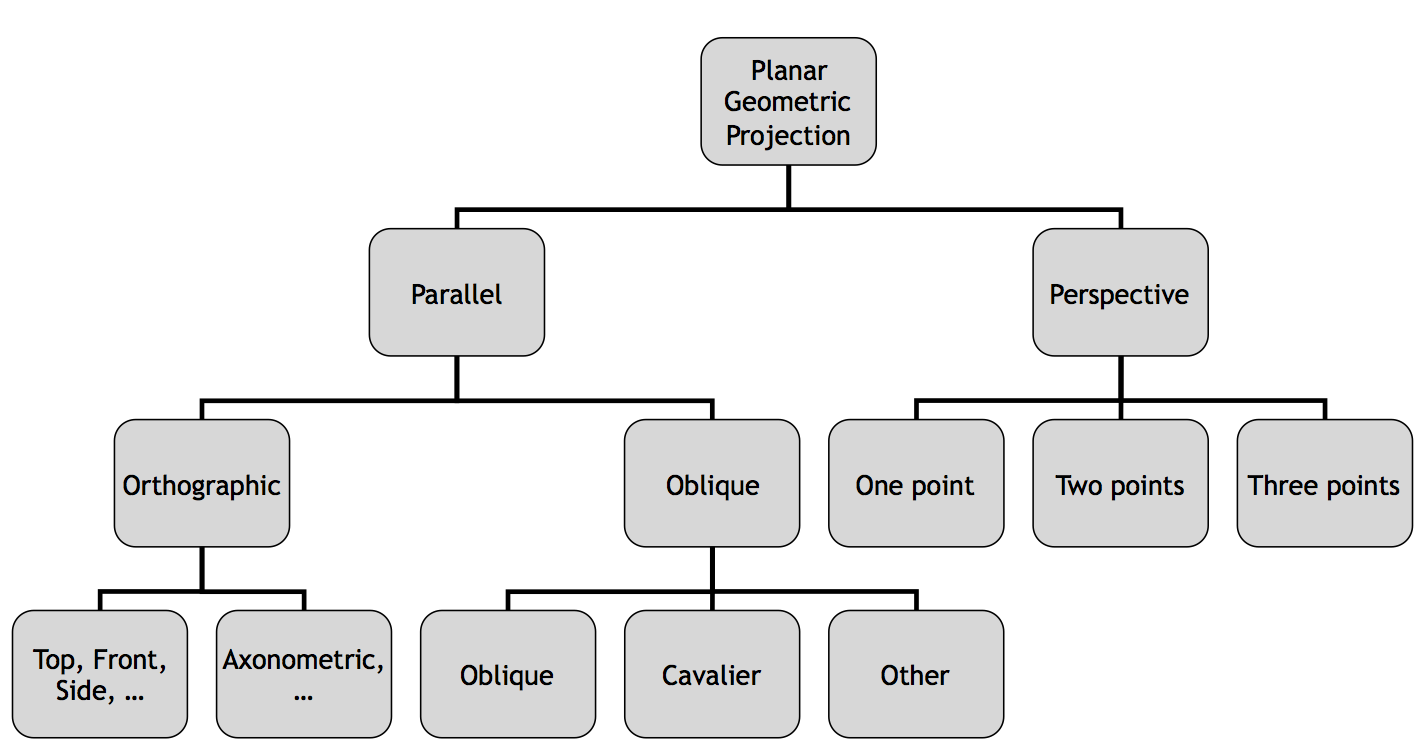
taxonomy of projections
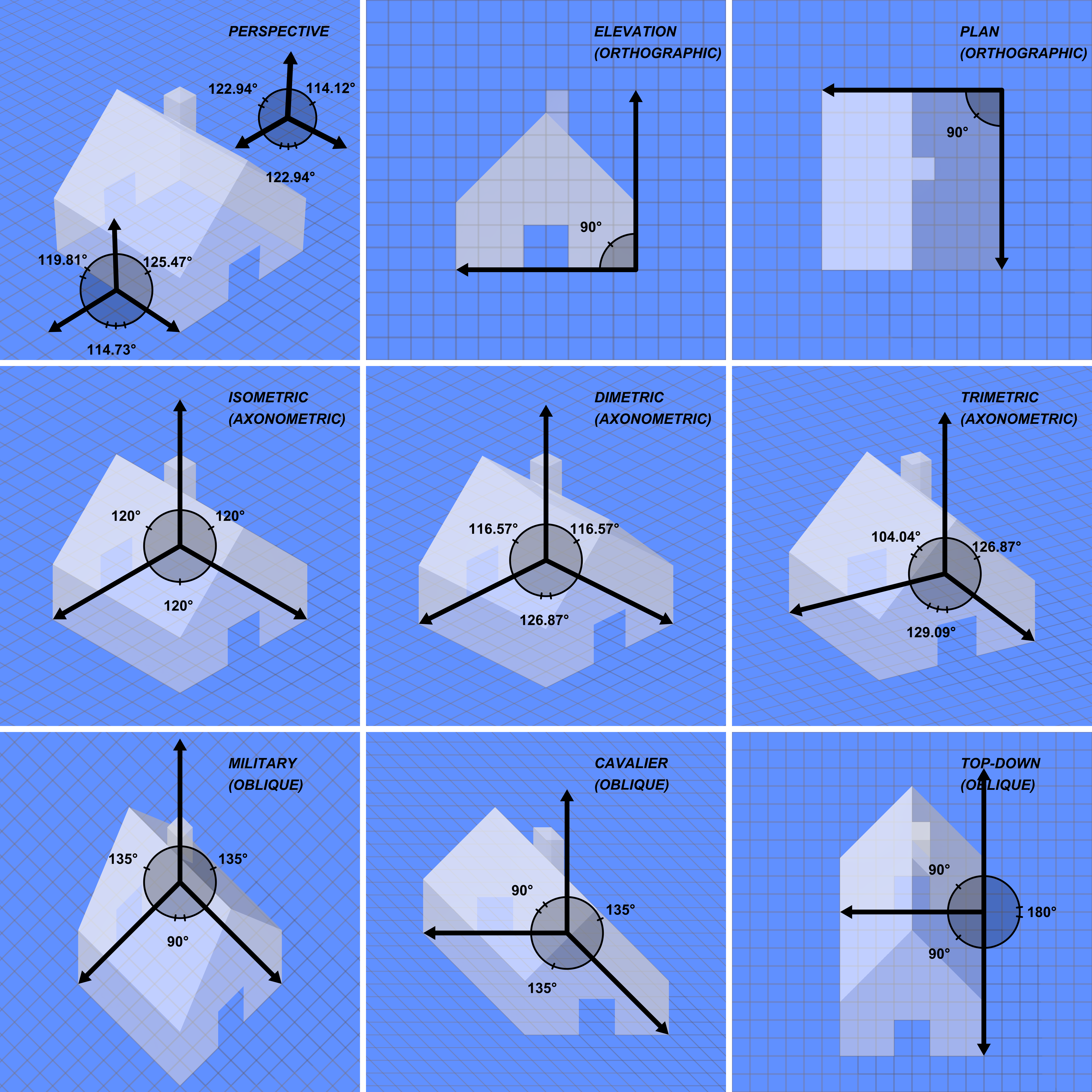
orthographic projection
box view volume
orthographic projection
viewing rays are parallel
orthographic projection
center around the \(\z\) axis
\[\mat{x' \\ y' \\ z'} = \mat{x/r \\ y/t \\ (2z - n - f)/(n-f)}\]
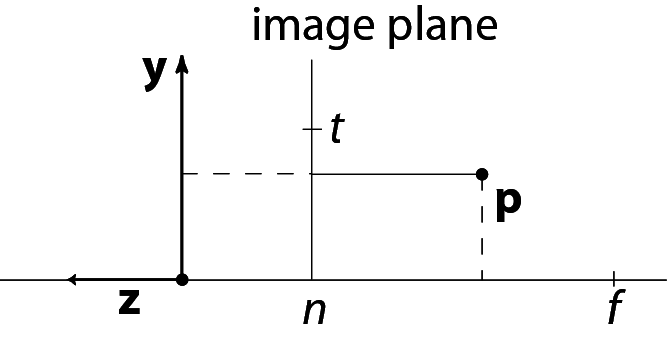
orthographic projection
in matrix form
\[O = \mat{1/r & 0 & 0 & 0 \\ 0 & 1/t & 0 & 0 \\ 0 & 0 & 2/(n-f) & -(n+f)/(n-f) \\ 0 & 0 & 0 & 1}\]
perspective projection
truncated pyramid view volume
perspective projection
viewing rays converge to a point
perspective projection
center around the \(\z\) axis
\[\mat{x' \\ y' \\ z'} = \mat{(nx)/(rz) \\ (ny)/(tz) \\ \cdots}\]
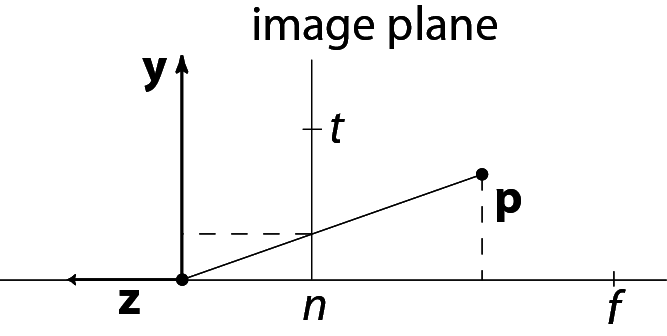
perspective projection
in matrix form
\[P = \mat{n/r & 0 & 0 & 0 \\ 0 & n/t & 0 & 0 \\ 0 & 0 & (f+n)/(n-f) & -2nf/(n-f) \\ 0 & 0 & 1 & 0}\]
projection matrices
- orthographic projection is affine
- perspective projection is not
- does not map origin to origin
- maps lines to lines
- parallel lines do not remain parallel
- length ratios are not preserved
- closed under composition
projection matrices
- the given matrices are simplified cases
- should be able to define more general cases
- non-centered windows
- non-square windows
- can find derivation, but it is a simple extension of these
- note that systems have different conventions
- pay attention to their definition
- sometimes names are the same
general orthographic
\[O = \mat{ \frac{2}{r-l} & 0 & 0 & \frac{l+r}{l-r} \\ 0 & \frac{2}{t-b} & 0 & \frac{b+t}{b-t} \\ 0 & 0 & \frac{2}{n-f} & \frac{n+f}{n-f} \\ 0 & 0 & 0 & 1 }\]
general perspective
\[P = \mat{ \frac{2n}{r-l} & 0 & \frac{l+r}{l-r} & 0 \\ 0 & \frac{2n}{t-b} & \frac{b+t}{b-t} & 0 \\ 0 & 0 & \frac{f+n}{n-f} & \frac{-2nf}{n-f} \\ 0 & 0 & 1 & 0 }\]