Directed Graphs
COS 265 - Data Structures & Algorithms
Directed Graphs
introduction
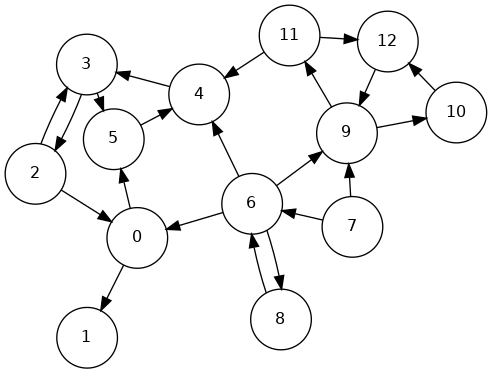
directed graphs
- Digraph
- Set of vertices connected pairwise by directed edges.

directed path from 8 to 1: red lines
directed cycle: blue lines
vertex 6 (green) has outdegree=4 and indegree=2
road network



political blogosphere graph

Overnight interbank loan graph

uber taxi graph

implication graph

combinational circuit

wordnet graph

digraph applications
| digraph | vertex | directed edge |
|---|---|---|
| transportation | street intersection | one-way street |
| web | web page | hyperlink |
| food web | species | predator-prey relationship |
| WordNet | synset | hypernym |
| scheduling | task | precedence constraint |
| financial | bank | transaction |
| cell phone | person | placed call |
| infectious disease | person | infection |
| game | board position | legal move |
| citation | journal article | citation |
| object graph | object | pointer |
| inheritance hierarchy | class | inherits from |
| control flow | code block | jump |
some digraph problems
| problem | description |
|---|---|
| s→t path | Is there a path from \(s\) to \(t\)? |
| shortest s→t path | What is the shortest path from \(s\) to \(t\)? |
| directed cycle | Is there a directed cycle in the graph? |
| topological sort | Can the digraph be drawn so that all edges point upwards? |
| strong connectivity | Is there a directed path between all pairs of vertices? |
| transitive closure | For which vertices \(v\) and \(w\) is there a directed path from \(v\) to \(w\)? |
| PageRank | What is the importance of a web page? |
directed graphs
digraph API
digraph api
Almost identical to Graph API

digraph api
// read digraph from input stream
In in = new In(args[0]);
Digraph G = new Digraph(in);

// print out each edge once
for(int v = 0; v < G.V(); v++)
    for(int w : G.adj(v))
        StdOut.println(v + "->" + w);
$ cat tinyDG.txt 13 22 4 2 2 3 ⋮ $ java Digraph tinyDG.txt 0->5 0->1 2->0 2->3 3->5 3->2 ⋮ |
 1st line: vertex count (\(V\)) |
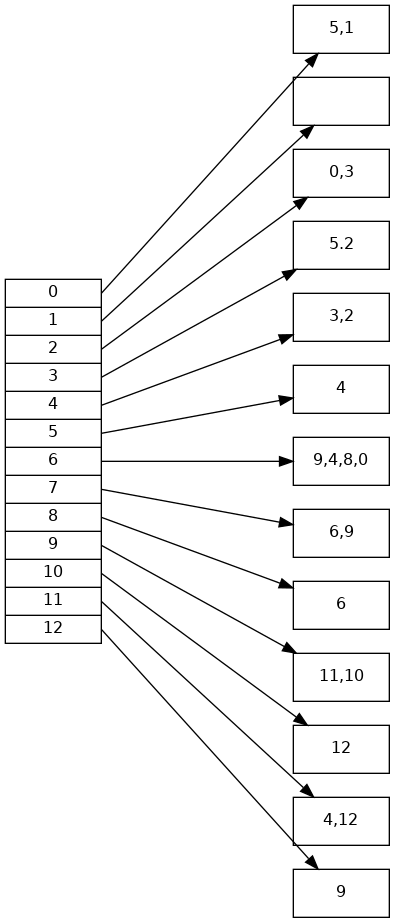
digraph representation: adjacency lists
Maintain vertex-indexed array of lists
 |
 |
digraph representations
In practice: use adjacency-lists representations
- Algorithms based on iterating over vertices pointing from \(v\)
- Real-world digraphs tend to be sparse (huge number of vertices, small average vertex degree)
| representation | space | insert edge from \(v\) to \(w\) | edge from \(v\) to \(w\)? | iterate over vertices pointing from \(v\) |
|---|---|---|---|---|
| list of edges | \(E\) | \(1\) | \(E\) | \(E\) |
| adjacency matrix | \(V^2\) | \(1^\dagger\) | \(1\) | \(V\) |
| adjacency lists | \(E + V\) | \(1\) | \(\mathrm{outdegree}(v)\) | \(\mathrm{outdegree}(v)\) |
\(^\dagger\)disallows parallel edges
adj-lists graph repr (review): java implementation
public class Graph {
    private final int V;
    private final Bag<Integer>[] adj;     // adj lists

    public Graph(int V) {
        // create empty graph with V vertices
        this.V = V;
        adj = (Bag<Integer>[]) new Bag[V];
        for(int v = 0; v < V; v++)
            adj[v] = new Bag<Integer>();
    }

    public void addEdge(int v, int w) {
        // add edge v-w (parallel edges and self-loops allowed)
        adj[v].add(w);
        adj[w].add(v);
    }

    // iterator for vertices adjacent to v
    public Iterable<Integer> adj(int v) {
        return adj[v];
    }
}
adj-lists digraph repr: java implementation
public class Digraph {
    private final int V;
    private final Bag<Integer>[] adj;     // adj lists

    public Digraph(int V) {
        // create empty graph with V vertices
        this.V = V;
        adj = (Bag<Integer>[]) new Bag[V];
        for(int v = 0; v < V; v++)
            adj[v] = new Bag<Integer>();
    }

    public void addEdge(int v, int w) {
        // add edge v->w
        adj[v].add(w);

    }

    // iterator for vertices adjacent to v
    public Iterable<Integer> adj(int v) {
        return adj[v];
    }
}
directed graphs
digraph search
reachability
Problem: Find all vertices reachable from \(s\) along a directed path

depth-first search in digraphs
Same method as for undirected graphs
- Every undirected graph is a digraph with edges in both directions
- DFS is a digraph algorithm
DFS (to visit a vertex v)
    Mark v as visited
    Recursively visit all unmarked verts w pointing from v
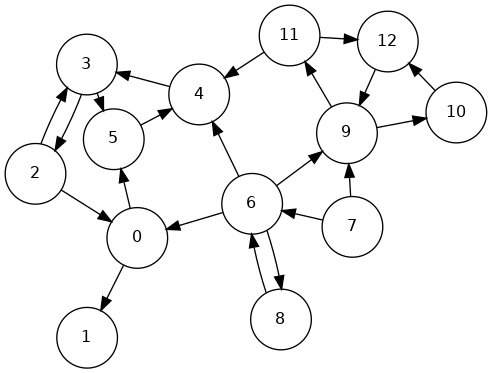
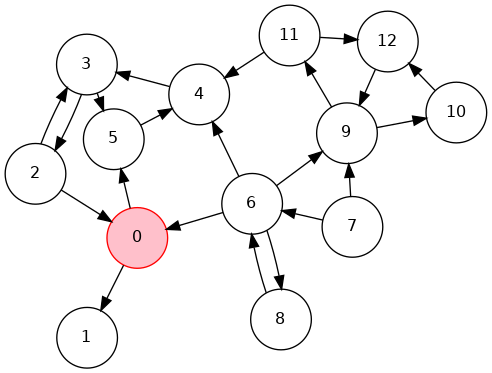
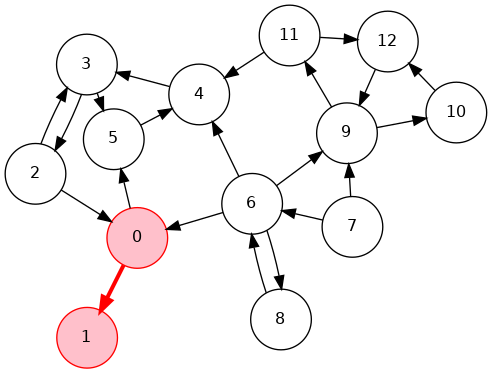
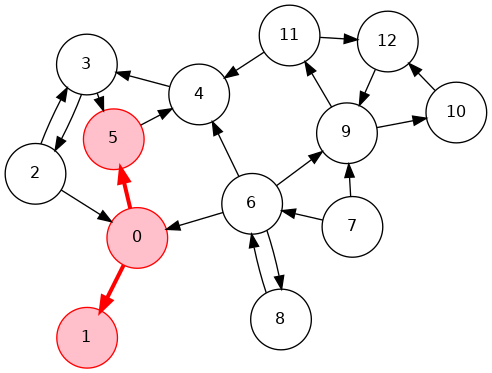
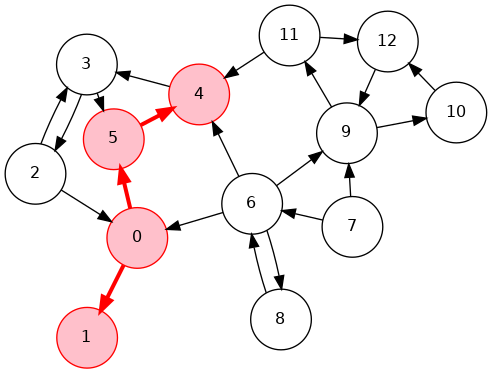
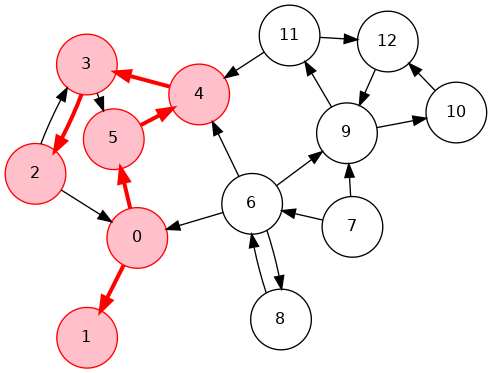
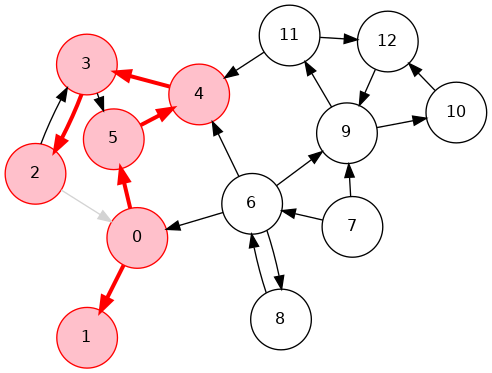
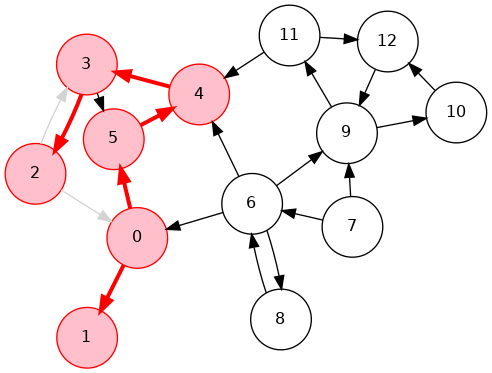
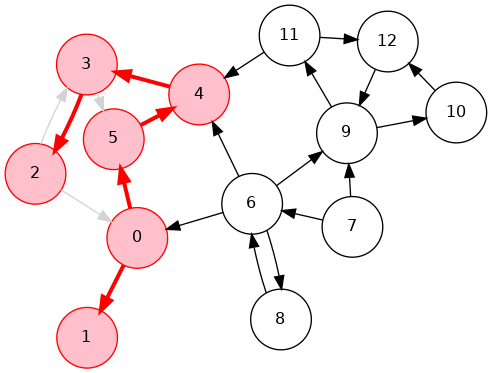
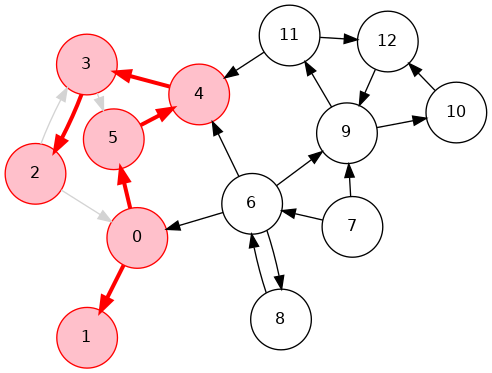
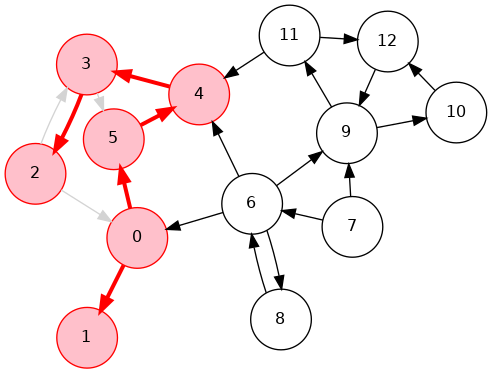
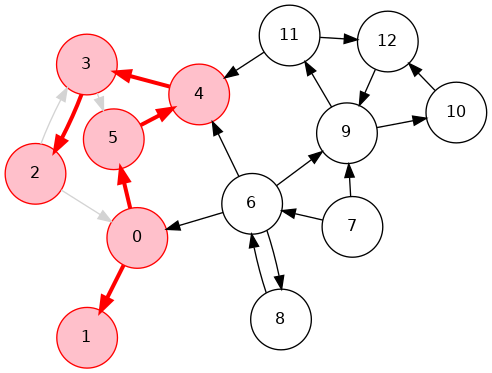
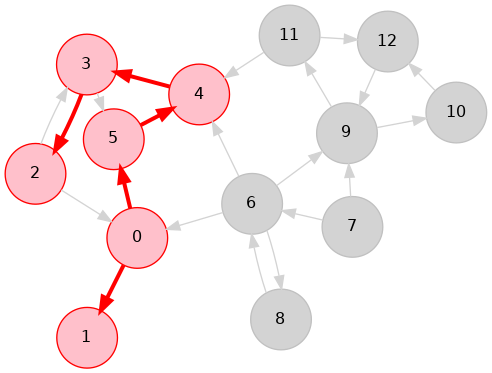
depth-first search demo
To visit a vertex \(v\):
- Mark vertex \(v\) as visited
- Recursively visit all unmarked vertices pointing from \(v\)
 |
|
 |
|
 |
|
 |
|
 |
|
 |
|
 |
|
 |
|
 |
|
 |
|
 |
|
 |
|
 |
|
depth-first search (in undirected graphs)
Recall code for undirected graphs.
public class DepthFirstPaths {
    private int s;
    private boolean[] marked;  // true if v connected to s
    private int[] edgeTo;      // prev vertex on path from s to v

    public DepthFirstPaths(Graph G, int s) {
        //  initialize data structures
        /* ...  */

        // find vertices connected to s
        dfs(G, s);
    }

    // recursive DFS does the work
    private void dfs(Graph G, int v) {
        marked[v] = true;
        for(int w : G.adj(v)) {
            if(!marked[w]) {
                edgeTo[w] = v;
                dfs(G, w);
            }
        }
    }
}
depth-first search (in directed graphs)
Directed graphs identical to undirected (sub Digraph for Graph)
public class DirectedDFP {
    private int s;
    private boolean[] marked;  // true if v connected to s
    private int[] edgeTo;      // prev vertex on path from s to v

    public DirectedDFP(Diraph G, int s) {
        //  initialize data structures
        /* ...  */

        // find vertices connected to s
        dfs(G, s);
    }

    // recursive DFS does the work
    private void dfs(Diraph G, int v) {
        marked[v] = true;
        for(int w : G.adj(v)) {
            if(!marked[w]) {
                edgeTo[w] = v;
                dfs(G, w);
            }
        }
    }
}
reachability application: program control-flow analysis

Every program is a digraph
- Vertex = basic block of instruction (straight-line program)
- Edge = jump
Dead-code elimination
- Find (and remove) unreachable code
Infinite-loop detection
- Determine whether exit is unreachable
reachability application: mark-sweep garbage collector

Every data structure is a digraph
- Vertex = object
- Edge = reference
Roots
- Objects known to be directly accessible by program (ex: stack)
Reachable objects
- Objects indirectly accessible by program (starting at a root and following a chain of pointers)
reachability application: mark-sweep garbage collector
Mark-sweep algorithm [McCarthy, 1960]
- Mark: mark all reachable objects
- Sweep: if object is unmarked, it is garbage (so add to free list)
Memory Cost: Uses 1 extra bit per object (plus DFS stack.)
depth-first search in digraphs summary

DFS enables direct solution of simple digraph problems
- Reachability
- Path finding
- Topological sort
- Directed cycle detection
Basis for solving difficult digraph problems
- 2-satisfiability
- Directed Euler path
- Strongly-connected components
Breadth-first search in digraphs
Same method as for undirected graphs
- Every undirected graph is a digraph (with edges in both directions)
- BFS is a digraph algorithm
BFS (from source vertex s):
    Put s onto a FIFO queue, and mark s as visited
    Repeat until the queue is empty:
        remove the least recently added vertex v
        for each unmarked vertex pointing from v:
            add to queue and mark as visited
Proposition: BFS computes shortest paths (fewest number of edges) from \(s\) to all other vertices in a digraph in time proportional to \(E+V\)
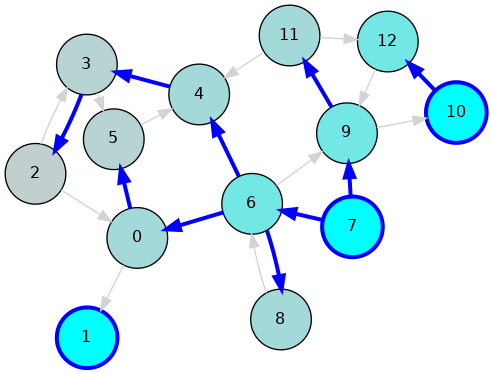
multiple-source shortest paths
- Multiple-source shortest paths
- Given a digraph and a set of source vertices, find shortest path from any vertex in the set to each other vertex
|
Ex: \(S = \{ 1, 7, 10 \}\) Shortest paths to...
|
 |
Q. How to implement multi-source shortest paths algorithm?
- Use BFS, but initialize by enqueueing all source vertices
breadth-first search in digraphs application: web crawler
Goal: Crawl web, starting from some root web page, say taylor.edu
Solution: (BFS with implicit digraph)
- Choose root web page as source \(s\)
- Maintain a queue of websites to explore
- Maintain a set of discovered websites
- Dequeue the next website and enqueue websites to which it links (provided you haven't done so before)
Q. Why not use DFS?
directed graphs
topological sort
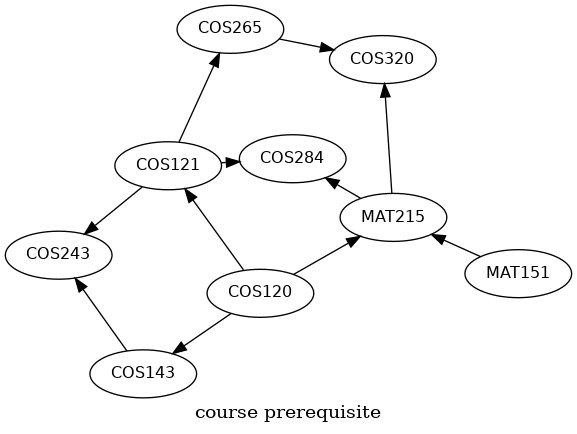
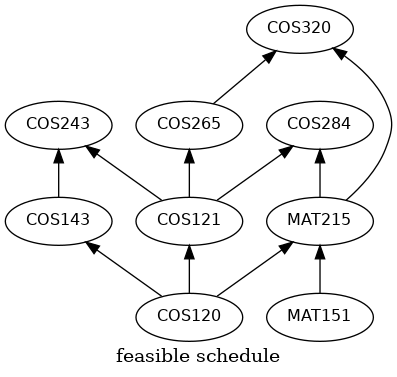
precedence scheduling
Goal: Given a set of tasks to be completed with precedence constraints, in which order should we schedule the tasks?
Digraph model: vertex = task; edge = precedence constraint
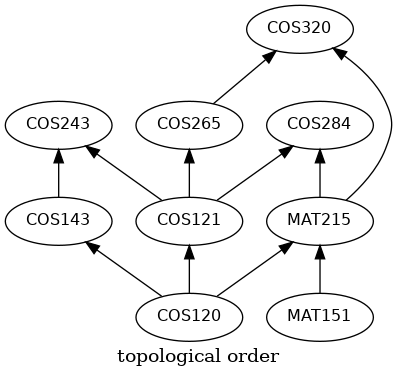
Tasks: COS120, COS121, COS143, COS243, COS265, COS284, COS320, MAT151, MAT215
 |
 |
precedence scheduling
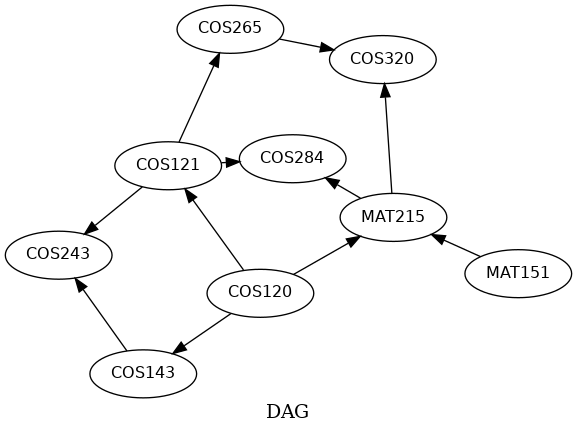
- DAG
- Directed Acyclic Graph
- Topological Sort
- Redraw DAG so all edges point upwards
Tasks: COS120, COS121, COS143, COS243, COS265, COS284, COS320, MAT151, MAT215
 |
 |
topological sort demo
Topological sort:
- Run depth-first search
- Return vertices in reverse postorder

topological sort demo

Topological sort:
- Run depth-first search
- Return vertices in reverse postorder

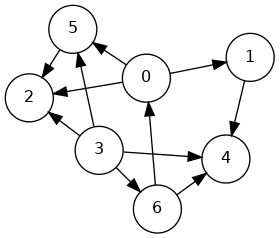
| Postorder | 4 1 2 5 0 6 3 |
| Topological Order | 3 6 0 5 2 1 4 |
depth-first search order
public class DepthFirstOrder {
    private boolean[] marked;
    private Stack<Integer> reversePostorder;

    public DepthFirstOrder(Digraph G) {
        reversePostorder = new Stack<Integer>();
        marked = new boolean[G.V()];
        for(int v = 0; v < G.V(); v++)
            if(!marked[v]) dfs(G, v);
    }

    private void dfs(Digraph G, int v) {
        marked[v] = true;
        for(int w : G.adv(v))
            if(!marked[w]) dfs(G, w);
        reversePostorder.push(v);
    }

    // returns all vertices in "reverse DFS postorder"
    public Iterable<Integer> reversePostorder() {
        return reversePostorder;
    }
}
topological sort in a DAG: correctness proof
Proposition: Reverse DFS postorder of a DAG is a topological order.
Pf: Consider any edge \(v \rightarrow w\). When dfs(v) is called:
- Case 1:
dfs(w)has already been called and returned. Thus, \(w\) was done before \(v\). - Case 2:
dfs(w)has not yet been called.dfs(w)will get called directly or indirectly bydfs(v)and will finish beforedfs(v). Thus, \(w\) will be done before \(v\). - Case 3:
dfs(w)has already been called, but has not yet returned. Can't happen in a DAG: function call stack contains path from \(w\) to \(v\), so \(v \rightarrow w\) would complete a cycle.
topological sort in a DAG: correctness proof
Proposition: Reverse DFS postorder of a DAG is a topological order.
dfs(0)
    dfs(1)
        dfs(4)
            // 4 done
        // 1 done
    dfs(2)     // 1 -> 2
        // 2 done
    dfs(5)
        // check 2
        // 5 done
    // 0 done
// check 1
// check 2
dfs(3)
    // check 2       (case 1)
    // check 4       (case 1)
    // check 5       (case 1)
    dfs(6)  //       (case 2)
        // check 0
        // check 4
        // 6 done
    // 3 done        <----
// check 4
// check 5
// check 6
// done
|
 When |
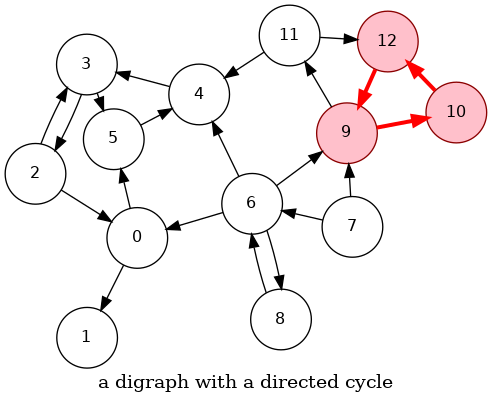
directed cycle detected
Proposition: A digraph has a topological order iff no directed cycle.
Pf:
- If directed cycle, topological order impossible
- If no directed cycle, DFS-based algorithm finds a topological order
|
Goal: Given a digraph, find a directed cycle. Solution: DFS. What else? see textbook |
 |
directed cycle detection application: precedence scheduling
- Scheduling
- Given a set of tasks to be completed with precedence constraints, in what order should we schedule the tasks?

Remark: A directed cycle implies scheduling problem is infeasible.
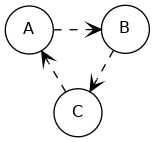
directed cycle detection application: cyclic inheritance
The Java compiler does cycle detection.
public class A extends B { }

public class B extends C { }

public class C extends A { }
|
 |
$ javac A.java
A.java:1: cyclic inheritence involving A
public class A extends B { }
       ^
1 error
directed cycle detection application: spreadsheet recalculation
Microsoft Excel does cycle detection (and has a circular reference toolbar!)


depth-first search orders
Observation: DFS visits each vertex exactly once. The order in which it does so can be important.
Orderings:
- Preorder: order in which
dfs()is called - Postorder: order in which
dfs()returns - Reverse postorder: reverse order in which
dfs()returns
private void dfs(Digraph G, int v) {
    marked[v] = true;
    preorder.enqueue(v);          // preorder (queue)
    for(int w : G.adv(v))
        if(!marked[w]) dfs(G, w);
    postorder.enqueue(v);         // postorder (queue)
    reversePostorder.push(v);     // reverse postorder (stack)
}
directed graphs
strong components
strongly-connected components
Def: Vertices \(v\) and \(w\) are strongly connected if there is both a directed path from \(v\) to \(w\) and a directed path from \(w\) to \(v\).
Key property: Strong connectivity is an equivalence relation:
- \(v\) is strongly connected to \(v\)
- If \(v\) is strongly connected to \(w\), then \(w\) is strongly connected to \(v\)
- If \(v\) is strongly connected to \(w\) and \(w\) to \(x\), then \(v\) is strongly connected to \(x\)
strongly-connected components
Def: A strong component is a maximal subset of strongly-connected vertices

connected components vs. strongly-connected components

\(v\) and \(w\) are connected if there is a path between \(v\) and \(w\). use connected component id, which is easy to compute with DFS.
//        0 1 2 3 4 5 6 7 8 9 10 11 12
// id[] = 0 0 0 0 0 0 1 1 1 2  2  2  2
public boolean connected(int v, int w) {
    return id[v] == id[w]; // const-time
}

\(v\) and \(w\) are strongly connected if there is both a directed path from \(v\) to \(w\) and a directed path from \(w\) to \(v\). strongly-connected component id (how to compute?)
//        0 1 2 3 4 5 6 7 8 9 10 11 12
// id[] = 1 0 1 1 1 1 3 4 3 2  2  2  2
public boolean stronglyConnected(int v, int w) {
    return id[v] == id[w]; // const-time
}
strong component application: ecological food webs
Food web graph
- vertex = species; edge = from producer to consumer

Strong component: subset of species with common energy flow
strong component application: software modules

Software module dependency graph:
- vertex = software module
- edge = from module to dependency

Strong component: Subset of mutually interacting modules
Approach 1: Package strong components together
Approach 2: Use to improve design!
strong components algorithms: brief history
1960s: Core OR problem
- Widely studied; some practical algorithms
- Complexity not understood
1972: linear-time DFS algorithm (Tarjan)
- Classic algorithm
- Level of difficulty: Algs4++
- Demonstrated broad applicability and importance of DFS
1980s: easy two-pass linear-time algorithm (Kosaraju-Sharir)
- Forgot notes for lecture; developed alg in order to teach it!
- Later found in Russian scientific literature (1972)
1990s: more easy linear-time algorithms
- Gabow: fixed old OR algorithm
- Cheriyan-Mehlhorn: needed one-pass algorithm for LEDA
Kosaraju-Sharir algorithm: intuition
Reverse graph: Strong components in \(G\) are same as in \(G^R\)
Kernel DAG: Contract each strong component into a single vertex
Idea:
- Compute topological order (reverse postorder) in kernel DAG
- Run DFS, considering vertices in reverse topological order


kosaraju-sharir algorithm demo
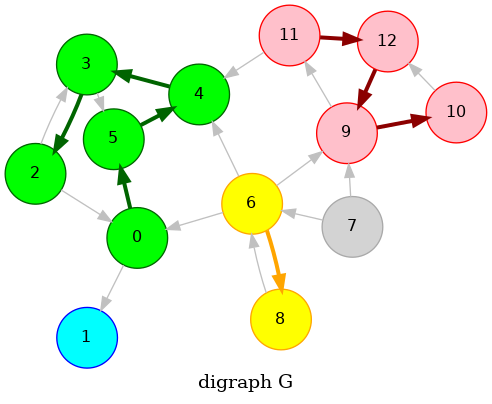
Phase 1: Compute reverse postorder in \(G^R\)
Phase 2: Run DFS in \(G\), visiting unmarked vertices in reverse postorder of \(G^R\)


kosaraju-sharir algorithm demo
Phase 1: Compute reverse postorder in \(G^R\)


0->6->8,6->7,0->2->3->4->5,4->11->9->12->10,1- postorder:
8 7 6 5 10 12 9 11 4 3 2 0 1 - reverse postorder:
1 0 2 3 4 11 9 12 10 5 6 7 8
kosaraju-sharir algorithm demo
Phase 2: Run DFS in \(G\), visiting unmarked vertices in reverse postorder of \(G^R\)
1 0 2 3 4 11 9 12 10 5 6 7 81 0 - - - 11 - -- -- - 6 7 -
 |
|
kosaraju-sharir algorithm
Proposition: Kosaraju-Sharir algorithm computes the strong components of a digraph in time proportional to \(E+V\)
Pf:
- Running time: bottleneck is running 2×DFS and computing \(G^R\)
- Correctness: tricky, see textbook
- Implementation: easy!
connected components in an undirected graph (with DFS)
public class CC {
    private boolean marked[];
    private int[] id;
    private int count;

    public CC(Graph G) {
        marked = new boolean[G.V()];
        id = new int[G.V()];

        for(int v = 0; v < G.V(); v++) {
            if(!marked[v]) {
                dfs(G, v);
                count++;
            }
        }
    }

    private void dfs(Graph G, int v) {
        marked[v] = true;
        id[v] = count;
        for(int w : G.adj(v)) {
            if(!marked[w]) dfs(G, w);
        }
    }

    public boolean connected(int v, int w) {
        return id[v] == id[w];
    }
}
strong components in a digraph (with two DFSs)
public class KosarajuSharirSCC {
    private boolean marked[];
    private int[] id;
    private int count;

    public KosarajuSharirSCC(Digraph G) {
        marked = new boolean[G.V()];
        id = new int[G.V()];
        DepthFirstOrder dfs = new DepthFirstOrder(G.reverse());
        for(int v : dfs.reversePostorder()) {
            if(!marked[v]) {
                dfs(G, v);
                count++;
            }
        }
    }

    private void dfs(Digraph G, int v) {
        marked[v] = true;
        id[v] = count;
        for(int w : G.adj(v)) {
            if(!marked[w]) dfs(G, w);
        }
    }

    public boolean stronglyConnected(int v, int w) {
        return id[v] == id[w];
    }
}
digraph-processing summary
| single-source reachability in a digraph |
|
DFS |
| topological sort in a DAG |
|
DFS |
| strong components in a digraph |
|
Kosaraju-Sharir DFS (twice) |